A really impressive white paper/book with insights about Tabular performance and inner-workings. Kudos to the authors for producing this colossal resource.
“Tabular models hosted in SQL Server 2012 Analysis Service provide a comparatively lightweight, easy to build and deploy solution for business intelligence. However, as you increase the data load, add more users, or run complex queries, you need to have a strategy for maintaining and tuning performance. This paper describes strategies and specific techniques for getting the best performance from your tabular models, including processing and partitioning strategies, DAX query tuning, and server tuning for specific workloads.”
https://prologika.com/wp-content/uploads/2016/01/logo.png00Prologika - Teo Lachevhttps://prologika.com/wp-content/uploads/2016/01/logo.pngPrologika - Teo Lachev2013-08-05 15:20:182016-02-15 11:32:08Performance Tuning of Tabular Models in SQL Server 2012 Analysis Services
“So, you have (or heard of) classic BI, self-service BI, Big Data BI, descriptive, predictive or even prescriptive BI, but do you have real-time BI? Real-time business intelligence (BI) has become one of the top priorities for data analytics. The ability of having near real-time access to large amounts of data across heterogeneous data sources is one of the key factors to enable effective business decisions. Join this talk to learn how to implement real-time analytics over streams of events using StreamInsight and .NET. You’ll see how these technologies come together in a Big Data Twitter demo that allows you to analyze the Twitter stream in real time.”
https://prologika.com/wp-content/uploads/2016/01/logo.png00Prologika - Teo Lachevhttps://prologika.com/wp-content/uploads/2016/01/logo.pngPrologika - Teo Lachev2013-07-21 18:33:542016-02-15 11:33:29Speaking at Atlanta Code Camp
Off the BI path but I wanted to save this tip for future generation and my sake in case I forget and I run into the same issue in Windows.NEXT or a new laptop. My $3,500 HP 3-year old EliteBook 8540w is prone to overheating. If a task puts a sustained pressure on the CPU, e.g. 10% or more, the fan engages and produces a noise like a howling wind in winter. It’s not so bad but it’s good enough to destroy my faith in HP… and embarrass me during meetings. The bottom of the laptop gets hot to a point where it can’t be used a laptop anymore. Eight months after I bought the laptop it became so bad that it would shut down from overheating so HP had to replace its motherboard and heat sink. And, now that the 3-year warranty expired it’s getting worse again.
Anyway, what got me curious is what causes CPU activity when the laptop is idle so I could minimize the level of its noise and embarrassment. I open the Windows 8 resource monitor (resmon.exe) and Task Manager side by side. I’ve noticed the problem gets worse when Office 2013 is running. This causes the Windows Search Index (SearchIndexer.exe) and SearchProtocolHost.exe to spring in the background, drawing more and more CPU time over time. I ran across a tip on the Internet that this happens if the Outlooks folders are above 2 GB in size. True, one of the Outlook archive folders and my main folder were above 2 GB so I had to do some pruning.
Another thing I’ve noticed is that the Antilmalware Service Executable (MsMpEng.exe), aka Windows Defender, will poke his head every now and then and draw some CPU cycles contributing to the CPU overhead. The Resource Monitor would show that the Antilmalware Service Executable would scan C:\Temp\fslogvw (the screenshot is meant to show how you can check what files a process accesses).
When this happens, the Task Manager would show mscorsvw.exe surging in CPU utilization. Mscorsvw.exe is precompiling .NET assemblies in the background, e.g. after a Windows update, so this is normal. When this happens, it generates .NET native images in C:\Temp\fslogvw so I had to exclude this folder and c:\windows\assembly from the Microsoft Defender real-time protection.
I left the Search Indexer to scan the new Outlook folders. When it was done it appeared that the CPU utilization is back to normal when the laptop was idle. One more tip. Disassemble the laptop and remove the fan cover as explained in the HP Maintenance and Service Guide. Then, clean the dust in the fan socket. In my case, there wasn’t much dust but you should probably start with cleaning if you run into overheating issues.
Expanding its Office 365 feature set, Microsoft introduced Power BI. Power BI is an umbrella name of the following BI offerings in the cloud: Power Pivot, PowerView, Power Query (previously known as Data Explorer), and Power Map (previously known as GeoFlow), plus more. Microsoft demonstrated Power BI at WPC yesterday (scroll to the 30th minute marker to see the Amir’s heart attack-provoking demo) or see the YouTube extract.
The “more” is the intriguing part to me:
Data Management Gateway – not sure how exactly this will work but it will provide some sort of connectivity to on-premise data so you can schedule PowerPivot data refreshes between the Microsoft cloud and your corporate data. Expect your ISP speed provider speed to be a limiting factor here so don’t hope for fast refreshes of millions of rows.
BI Sites – a dedicated SharePoint site that will support finding and collaborating on BI artifacts.
Mobile support – Power View is going HTML5!
Natural language query – Amir covered this interesting feature pretty well. I don’t know how it works behind the scenes yet (probably a natural language-to-DAX translator).
Data views – data stewards can publish datasets so they can be easily discoverable by Power Query.
King of the Hill – an interesting new PowerView visualization (demonstrated by Amir toward the end of the demo).
We don’t know at this point when these features will make to on-premise SharePoint, which probably would have been a better starting point for these enhancements. And, pricing hasn’t been announced yet. Look for Power BI toward the end of the summer if cloud self-service BI makes sense to your organization.
https://prologika.com/wp-content/uploads/2016/01/logo.png00Prologika - Teo Lachevhttps://prologika.com/wp-content/uploads/2016/01/logo.pngPrologika - Teo Lachev2013-07-09 23:28:002021-02-16 04:29:13Power BI Expands Microsoft Cloud Self-service BI
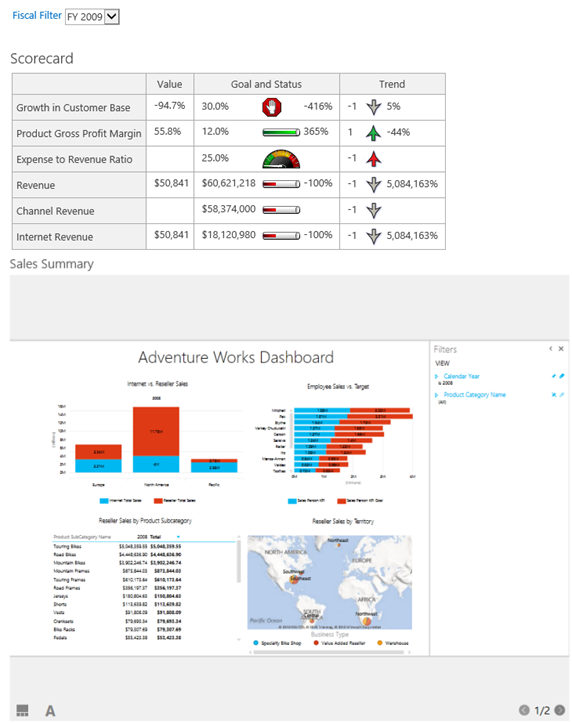
Issue: A client reports an issue with our PerformancePoint dashboard where the clicking a KPI in the scorecard doesn’t show the supporting analytical grid. Normally, when the user clicks a row in the Operational Scorecard (see the image below), the SharePoint connectable architecture triggers an update of the Operational Detail Report Months analytical report that shows more details about the selected KPI.
Workaround: Finding the cause was tricky. To make things even trickier, the SQL Server Profiler would show “Query (1, 36) Parser: The syntax for ‘,’ is incorrect.” error so you would believe that there is something wrong with the MDX queries. This turned out to be an “innocent” error if there is such a thing. The reason for the issue with the report refresh not working was actually a PerformancePoint Display Condition bug presumably introduced by a recent SharePoint upgrade (more than likely the April CU). The display condition actually works if you put the page in Edit mode. While waiting for a fix from Microsoft, the workaround I found is to enable a default display condition:
Open the dashboard in the Dashboard Designer.
In the Analytical Report web part, right-click the Display Condition and then Edit Condition.
Check the Default checkbox and redeploy the dashboard.
This displays the default configuration of the Analytical Grid report which the user will see when opening the dashboard page. For some reason, this makes the KPI row clicks work. Sometimes, things get worse before getting better…
https://prologika.com/wp-content/uploads/2016/01/logo.png00Prologika - Teo Lachevhttps://prologika.com/wp-content/uploads/2016/01/logo.pngPrologika - Teo Lachev2013-07-03 12:54:002016-02-15 11:42:04PerformancePoint Display Condition Not Working
Microsoft released the Community Technology Preview 1 (CTP1) of SQL Server 2014. As I mentioned in my previous post, the accompanying Product Guide should get you started with the new features.
https://prologika.com/wp-content/uploads/2016/01/logo.png00Prologika - Teo Lachevhttps://prologika.com/wp-content/uploads/2016/01/logo.pngPrologika - Teo Lachev2013-06-26 12:20:162016-02-15 11:46:20Microsoft SQL Server 2014 Community Technology Preview 1 (CTP1) Released
In anticipation of SQL Server 2014 CTP1, which should be out soon, Microsoft released Microsoft SQL Server 2014 CTP1 Product Guide – a collection of white papers, slides, and other resources that discuss the new features to help you evaluate SQL Server 2014.
“The SQL Server 2014 CTP1 Product Guide is now officially available to customers and partners. The guide is intended to help you get the most value out of Microsoft SQL Server 2014 CTP1.”
https://prologika.com/wp-content/uploads/2016/01/logo.png00Prologika - Teo Lachevhttps://prologika.com/wp-content/uploads/2016/01/logo.pngPrologika - Teo Lachev2013-06-23 18:29:002016-02-15 11:47:40Microsoft SQL Server 2014 CTP1 Product Guide Released
The Atlanta Microsoft BI Group will have a meeting tomorrow, June 24th.
Main Presentation: Developing a Custom Task in SSIS 2012 Level: Intermediate
Date: June 24th Time 6:30 – 8:30 PM ET
Place: South Terraces Building (Auditorium Room) 115 Perimeter Center Place Atlanta, GA 30346
Overview: Integration Services uses tasks to perform units of work in support of the extraction, transformation, and loading of data. Integration Services includes a variety of tasks that perform the most frequently used actions, from executing an SQL statement to downloading a file from an FTP site. If the included tasks and supported actions do not completely meet your requirements, you can create a custom task. In this session we will demonstrate to you how to create custom SSIS tasks.
Speaker: Aneel Ismaily was born and raised in Karachi, Pakistan. He moved to the United States at the age of 18. Since then he has lived in Atlanta, GA. Aneel did his undergrad in Computer Science (BS) from Georgia State University (GSU) with concentration in Database Systems. He recently graduated with a professional MBA degree from Georgia State University with concentration in Organization Management and Entrepreneurship. Aneel owns MSBI Consulting, an IT consulting firm. MSBI Consulting provides Business Intelligence solutions to its customers. Prior to MSBI Consulting, Aneel was employed with Intellinet where he was working as a Principal Consultant. Before that he worked at RDA Corporation where he was working as a Sr. Software Engineer and before RDA he worked as a BI Solution Developer at BCD Travel. You can learn more about Aneel at http://www.linkedin.com/in/aismaily.
Sponsor: 3Sage Consulting Founded and led by real consultants who really care about the end deliverable, 3sage is untangling some of the most complex data issues in business today.
Prototypes with Pizza: Real-time BI with Big Data Demo by Teo Lachev
So, you have classic BI, self-service BI, Big Data BI, predictive BI, but do you have real-time BI? To demonstrate how classic BI, Big Data, and real-time BI can play together, Microsoft put together a great sample – Big Data Twitter Demo.
https://prologika.com/wp-content/uploads/2016/01/logo.png00Prologika - Teo Lachevhttps://prologika.com/wp-content/uploads/2016/01/logo.pngPrologika - Teo Lachev2013-06-23 17:38:002016-02-15 11:49:59Atlanta BI Group Meeting on Monday
So, you have (or heard of) classic BI, self-service BI, Big Data BI, descriptive BI, predictive BI or even prescriptive BI, but do you have real-time BI? I’ve been doing quite bit of research and work in that area lately. As you could imagine, real-time BI requires a different architecture that is capable of processing streams of data (sometimes thousands of events) in real time. The Microsoft premium technology for Complex Event Processing (CEP) is StreamInsight (requires a SQL Server license). Microsoft has also a lightweight, open-source .NET library called RX which does event streaming but it doesn’t have many of the StreamInsight features, such as windowing. To demonstrate how classic BI, Big Data, and real-time BI can play together, Microsoft put together a great sample – Big Data Twitter Demo.
The demo allows you to subscribe to one or more Twitter topics of interest. It uses StreamInsight to listen to the Twitter activity and extract tweets that match the topics you “subscribe” to. In the screenshot below, I’m intercepting tweets about Microsoft and SQL Server. Then the demo saves the results to a SQL server table for offline analysis with PowerPivot and Power View (a sample Excel workbook with reports is included). In addition, the demo stores the results in a SQL Azure Hadoop cluster (HDInsight). I guess the idea is to truncate the operational SQL Server store on a regular basis while archiving all data on Hadoop for future analysis. The demo also includes a dashboard that displays the matching tweets and hit rate in real time. Behind the scenes, the application uses Web Sockets (IMO, SignalR would have been a better choice here since Web Sockets have limited browser and platform support) to communicate with the JQuery code on the client which updates the dashboard content. For more information about how all of this work, Mike Wilmot covers the demo in more details.
This is a very impressive demo and I can imagine how much effort went into building it. I personally believe that we’ll see more demand for real-time applications, especially coupled with predictive analytics, such as detecting outliers or forecasting volumes.On the downside, a few days after Microsoft released the demo, Twitter discontinued Basic Authentication, which the demo uses to authenticate with Twitter (you need a Twitter account to run it). Twitter now uses OAuth so I had to tweak the code. Specifically, I added the OAuthTokens.cs and WebRequestBuilder.cs from the Patrick Smith’s Twitterizer library to the StreamInsight.Demos.Twitter.Common class library in the demo. In the same library, I changed the Read method in the TwitterStreaming class as follows:
publicTextReader Read() {
var url = GetURL();
// Basic Authencation – Obsolete
//var request = HttpWebRequest.Create(url);
//request.Timeout = _config.Timeout;
//request.Credentials = new NetworkCredential(_config.Username, _config.Password);
//var response = request.GetResponse();
// Twitter uses OAuth now which is much more complex to implement so you need wrapper classes, such as Twitterizer
And, to get the dashboard to work, I had to use Safari since for some obscure reason Web Sockets won’t work for me with IE 10 on Windows 8. If I have time, I plan to cover StreamInsight and real-time BI in more details in future posts.
Issue: A customer reports an issue with a production SSAS Tabular instance not starting after reboot. The server has also an SSAS Multidimensional instance which starts just fine. There are no interesting messages in the Event Viewer.
Resolution: During installation, the customer has configured the LogDir of both instances to point to the same physical folder. However, the Flight Recorder can’t start on the Tabular instance because the log file is already locked by the Multidimensional instance. The solution to this horrible problem was to reconfigure the LogDir setting of the Tabular instance (in SSMS, connect to the SSAS instance, right-click the server, and click Properties) to a separate folder.
Moral: Always separate DataDir, LogDir and TempDir folders so each instance has its own set of folders.