Power BI churns out new features fast but not all features are available everywhere. As one of the most confusing aspects of Power BI, feature availability depends on the data acquisition method (data import vs live connections) and across Power BI product offerings (Power BI Desktop, Power BI Service, Power BI Report Server, and Power BI Mobile). Microsoft has left gaps in the product documentation and UI to clearly indicate feature availability. For example, while you can add a Q&A button in Power BI Desktop irrespective of whether you import or connect live, the button won’t work with live connections because Q&A for Creators is available only when data is imported.
This blog is my first attempt to clarify the feature availability based on the data acquisition method. All features work when you import data. Therefore, this option is not listed in the table. Direct connections however and not that fortunate. DirectQuery is when you connect directly to all data sources except Analysis Services. Because Power BI knows more about Analysis Services, direct connectivity to Analysis Services is listed separately. A while back I asked Microsoft why certain features are not supported with live connections to Analysis Services, especially to Tabular. To me, there shouldn’t be any difference between data import and using an external Tabular connection. At the end, it’s all Tabular behind the scenes. The answer back then was related to performance concerns for chatty features with external Tabular models. I continue pushing to eliminate these discrepancies if possible over time and provide more feature parity. The table omits features that are supported by the three connectivity options.
DirectQuery
Live Connection to Analysis Services1
Binning
Yes
No
Calculated column
Yes2
No
Calculated measure
Yes2
Yes2
Change field data type
Yes
No
Change field formatting
Yes
No
Clustering
No
No
Custom groups
Yes
No
Data categories for fields
Yes
No
Explain Increase/decrease (Power BI Desktop)
No
No
Fields properties
Yes
No
Hierarchies
Yes
No
Power Query
Yes
No
Q&A in dashboards (Q&A for consumers)
No
Tabular only
Q&A in reports (Q&A for creators)
No
No
Quick Insights (Power BI Service)
No
No
Relationships
Yes
No
Row-level Security (Power BI Desktop)
Yes
No3
Synonyms
Yes
No
What-if
No
No
In general, besides calculated measures for Tabular, no modeling features are available with live connections to Analysis Services. This makes sense to avoid a semantic model (Power BI Desktop) over a semantic model in Analysis Services. In fact, Data, Relationships, and Query Editor (Power Query) are not available when connecting directly to Analysis Services.
See this page for DAX limitations in DirectQuery mode.
Analysis Services has its own security mechanism.
https://prologika.com/wp-content/uploads/2016/01/logo.png00Prologika - Teo Lachevhttps://prologika.com/wp-content/uploads/2016/01/logo.pngPrologika - Teo Lachev2018-06-10 15:14:482018-06-11 16:10:25Power BI Feature Discrepancies for Data Acquisition
MS BI fans, join us for the next Atlanta MS BI and Power BI Group meeting on Monday, May 21st at 6:30 PM. Paco Gonzálezwill take us into a deep dive into Microsoft Cognitive Services and how to integrate them with Power BI. SolidQ will sponsor the meeting. And your humble correspondent will introduce you to Power BI Premium incremental refresh. For more details, visit our group page and don’t forget to RSVP (use the RSVP survey on the main page) if you’re planning to attend.
Atlanta BI Group May 21st Meeting Reminder
Please RSVP to help us plan food by 2 PM on the day of the meeting by latest:
Choose Yes and submit the RSVP survey found at the right top corner of the page.
Please note that the voting system tracks votes by cookies. If you don’t see the option to submit the survey, clear your browser cookies, or right-click the Internet Explorer icon, and then click Start InPrivate Browsing. Free covered parking is available at South or North Terraces. Or, use the free open non-ticket parking next to North Terraces (coming north on Ashford Dunwoody, turn left on Perimeter Center Terrace and them immediately right).
Presentation:
Artificial Intelligence, Cognitive Services, and Power BI
Level: Intermediate
Date:
May 21, 2018
Time
6:30 – 8:30 PM ET
Place:
South Terraces Building (Auditorium Room)
115 Perimeter Center Place
Atlanta, GA 30346
Overview:
Microsoft Cognitive services is a series of services based on Microsoft Research using Deep Learning techniques, ready for you to enrich your unstructured data. Microsoft Services includes: Vision (Computer Vision, Emotion, Face, Video), Speech/Language (Speaker Recognition, Spell, Sentiment, Language, Key Phrases, Topic detection, Linguistic Analysis), Knowledge, and Search. These services are consumed by using the Cognitive Services APIs. Power BI enables you to consume the APIs to enrich your unstructured data inside your Power BI solutions. During this session, we will cover how to consume the API using Power Query to then visualize the results with Power BI visuals. We will also consume the Cognitive services API by using a R script inside Power BI. This session is structured with a B2C Survey case study solution with a real time Dashboard using a streaming dataset.
Speaker:
SolidQ North America’s CEO, Paco González specializes in helping organizations become “data driven” from a strategic and technical perspective. He is a speaker at small and large conferences such as PASS Summit, Ignite, DevWeek London, or PAW. Paco focuses in Business Analytics and Artificial Intelligence. Paco has published several books and whitepapers. A Microsoft Certified Trainer and Microsoft Certified Professional. Paco is based in Atlanta.
Sponsor:
The tools and technologies to manage information will constantly evolve, but the need for accurate and actionable information is timeless. SolidQ delivers services for Microsoft platforms that help you architect, integrate and optimize your use of data. The result? Our clients think bigger and move faster because we help them build the capacity and skills to interact with data in creative, collaborative ways that deliver new insights to the business. At SolidQ we measure our success by your satisfaction – and we guarantee it.
https://prologika.com/wp-content/uploads/2016/01/logo.png00Prologika - Teo Lachevhttps://prologika.com/wp-content/uploads/2016/01/logo.pngPrologika - Teo Lachev2018-05-14 08:01:112021-02-17 01:01:21Atlanta MS BI and Power BI Group Meeting on May 21
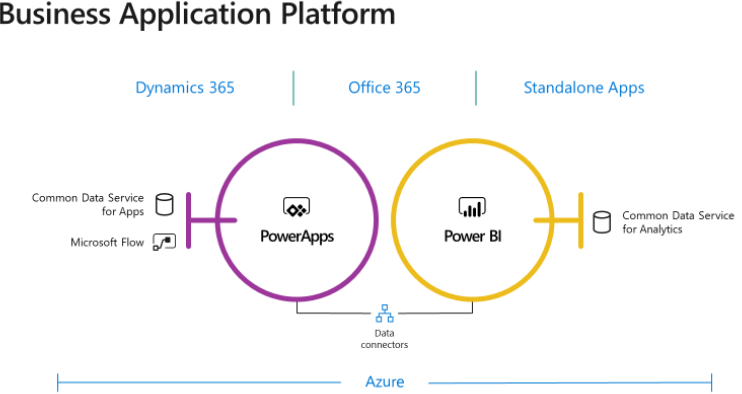
BI and data integration projects often benefit from an operational data source (ODS), whose benefits and design I discussed in my “Designing an Operational Data Store (ODS)” newsletter. Think of the Microsoft Common Data Service for Apps (CDS for Apps) as a cloud ODS by Business and for Business. Officially introduced in 2016 and running on Azure SQL Database, CDS for Apps is now the entity and data model behind Dynamics 365. This is where Dynamics 365 stores its data. Microsoft is readying a preview of another CDS flavor (CDS for Analytics) in June 2018. Think of CDS for Apps as the OLTP version of the ODS and is designed for transactions (this is why it’s layered on top of SQL Server), while CDS for Analytics is oriented towards OLAP (this is why is layered on top of Azure Storage).
Both CDS types support standardized entities, whose definitions are documented in the GitHub repository of the Common Data Model. Currently, the schema of these entities is designed and controlled by Microsoft and it’s limited to Dynamics entities, such as Account, Opportunity, and so on. However, Microsoft hopes that other vendors will provide solutions and extend the CDS schema. Of course, because CDS is your database, you can extend it with your own custom entities. The rest of the document focuses on CDS for Apps only.
The Good
There is a lot to like about CDS for Apps. Let’s start with pricing. Other vendors, such as Oracle and Teradata, have similar visions and products but their offerings are very expensive. The CDS for Apps pricing is included in the PowerApps licensing model because PowerApps is the primary client for creating CDS for Apps-centered solutions. Using CDS outside selected Dynamics 365 plans (that include it already) will cost you at least $7 per user and per month.
CDS for Apps is more than just a data repository. It’s a business application platform with a collection of data, business rules, processes, plugins and more. In this regard, it resembles SQL Server Master Data Services (MDS). The modeler can:
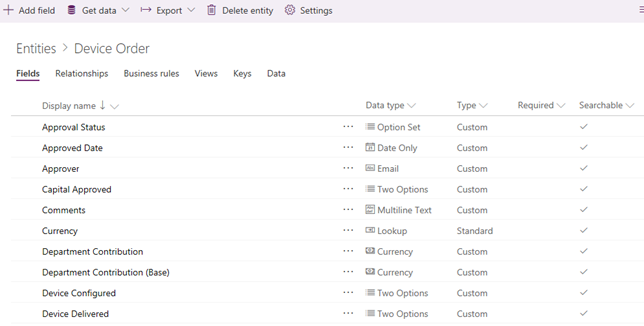
Define and change entities, fields, relationships, and constraints. For example, the screenshot shows a custom Device Order entity that I’ve created.
Business rules, such as to prepopulate Ship Date based on Order Date.
Secure data to ensure that users can see it only if you grant them access. Role-based security allows you to control access to entities for different users within your organization.
Besides the original PowerApps canvas apps (like InfoPath forms), CDS for Apps also opens the possibility to create model-driven PowerApps applications (require PowerApps P2 plan). Model-driven apps are somewhat like creating Access data forms but more versatile. Because PowerApps knows CDS for Apps, you can create the app bottom-up, i.e. start with CDS for Apps and then generate the app based on the actual schema and data. For example, you can use PowerApps to build a model-driven app for implementing the workflow for approving a certain process. Model-driven apps are a new style of a PowerApps application that makes it easy to build entity forms, entity views, and workflows.
How do you get data into CDS for Apps custom entities? Your PowerApps app can write to it. Or, you can create and schedule a project that uses Power Query (yep, the same one as in Power BI) to load data from somewhere into CDS for Apps.
The Bad
How do you get data out from CDS for App, such as to import data from some entities into a Power BI model? Microsoft has released a preview build of the Common Data Service for Apps connector for Power BI. However, this connector is even slower that the Dynamics connector. It uses the OData v4 Web API. Based on my limited tests, it took the connector about a minute to download 40,000 rows from Dynamics, clocking 10% slower than the Dynamics connector. To make things worse, the connector doesn’t support query folding, so Power BI must download the entire dataset before Power Query applies filters. Because the connector doesn’t support also REST filter and select predicates, so you can’t filter data or select a subset of columns at the source. Microsoft is actively working on improving the connector performance and it might get better in time.
Continuing down the list of limitations, CDS for Apps doesn’t support change tracking (to capture changes to a given row) and incremental loads, such as to load or refresh only the data that has changed yesterday or previous month. These are all essential features that could make ODS even more valuable.
The Ugly
For years people were complaining that after migrating from the on-premises Dynamics to the cloud, they lost the ability to connect to its database directly and they had to rely on the REST APIs (slow) or Data Export Service to export the data to an SQL Server Database (fast but requires additional effort and budget). Unfortunately, although CDS for Apps stores data in Azure SQL Database, Microsoft doesn’t expose its database directly to get data out fast and bypass the REST endpoint. When I raised this issue to Microsoft I got feedback that CDS for Apps is a business platform and there are layers on top of data to handle security, rules, calculations, and so on. However, the argument that CDS for Apps is more than just a database is nonsensical to me. Try to explain to a customer that cakes have layers and CDS for Apps has layers, and therefore getting something out of it is slow. As I mentioned, the “layered nature” of the CDS is conceptually like MDS. In fact, I see a lot of overlap. MDS also supports rules, security, etc. but it doesn’t force me to go through the web service interface if all I need is the raw data. Hence, my wish to support direct connectivity to the Azure SQL Database endpoint of CDS for Apps.
The success of Common Data Services for Apps will depend largely on adoption and contributions by Microsoft partners. Although it lacks typical ODS features and fast connectivity, CDS for Apps gains in “business platform” features. It will be interesting to see how much traction it will gain with business users as a staging area given that CDS for Apps is designed from ground up for business users.
https://prologika.com/wp-content/uploads/2016/01/logo.png00Prologika - Teo Lachevhttps://prologika.com/wp-content/uploads/2016/01/logo.pngPrologika - Teo Lachev2018-05-12 17:40:282018-05-22 13:30:27Microsoft Common Data Service for Apps: The Good, the Bad, the Ugly
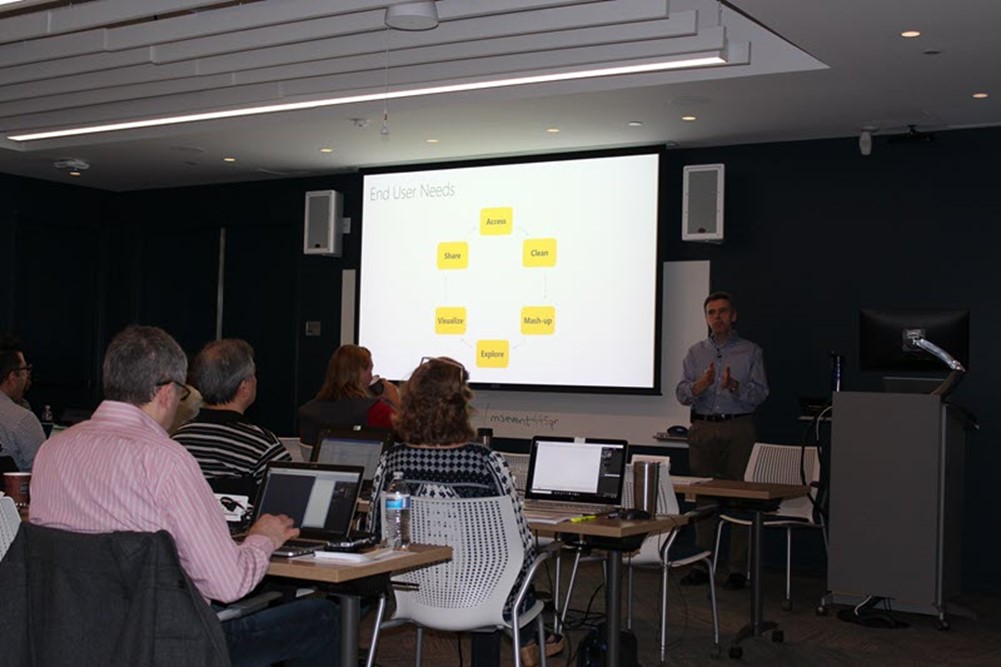
Thank you to everyone attending the Power BI workshop by Prologika yesterday. We had another great turnout with more than 50 people from 30+ companies attending the event at the Microsoft Technology Center in Alpharetta! Kudos to Eric Flamm and Michael Folarinde for the great job proctoring the event. Here is some feedback that the attendees shared in the post-event survey:
“I was frustrated and confused with using Power BI service and Desktop because I didn’t know how to manipulate the visualizations, slicers, etc. and thought the tools were not capable. I walk away from this now knowing this information and excited to use the tools to transform data to help our business.”
“Very informative and showed me new things despite me using PBI for a few months.”
“Very instructive and knowledgeable of our instructor Teo. He is very patient and answered all my questions.”
“The presenter was great. He was obviously very knowledgeable, was great at explaining the concepts, and was very patient.”
“The presenter, Teo, was extremely knowledgeable of Power BI. He presented the material in a clear and easy to follow format. He was able to answer all levels of questions from beginner to advanced and even questions regarding infrastructure and how to implement Power BI into small or large organizations. I really enjoyed that we were given time to actually perform the various tasks ourselves and then get help along the way. It really helped to reinforce the lessons we had just learned.”
“…The instructors were very helpful with any questions.”
And my next week is entirely booked with more Power BI training. It’s great to witness and participate in the great momentum surrounding Power BI!
https://prologika.com/wp-content/uploads/2016/01/logo.png00Prologika - Teo Lachevhttps://prologika.com/wp-content/uploads/2016/01/logo.pngPrologika - Teo Lachev2018-05-11 16:52:212018-05-11 16:53:30Another Successful Power BI Workshop
In my “Why Business Like Yours Choose Power BI Over Sisense” blog, I discussed how Sisense seeks a competitive advantage by offering a user-friendly designer connected to the their ElastiCube, thus claiming that Sisense is a better choice with larger datasets because business users don’t have to use professional tools (Visual Studio) or deploy to external servers. Things have changed in Power BI since then. Microsoft increased the dataset size to 1 GB (Power BI Pro) and 10 GB (Power BI Premium). A 10 GB compressed dataset is a lot of data (probably allowing you to import over a billion rows). But fully refreshing a large dataset is no fun and it can take many hours (see my blog “Processing AAS Models Asynchronously” for some stats).
Fortunately, the May release of Power BI Desktop brings incremental refresh, which a feature that was previously only available in Analysis Services. As its name suggests, the primary goal is to reduce the time required to refresh datasets with imported data by processing only data that has changed instead of the entire dataset.
I was involved and provided feedback during the prerelease testing of Power BI incremental refresh. Without reiterating the documentation, here are some things you need to pay attention to:
Incremental refresh is a Power BI Premium feature. Although you configure it in Power BI Desktop, you can’t test it in Power BI Desktop. You must deploy the file to a premium workspace to put it in action. I provided feedback that this feature should be also available in shared capacity workspaces because its primary goal is to reduce resources in a shared environment but as it stands incremental refresh is a premium feature.
Associate the RangeStart and RangeEnd query parameters in a custom filter to one column in the table set up for incremental refresh. During development, it makes sense to load a subset of the data, such as for only one year. So, set RangeStart and RangeEnd accordingly.
When you define a custom filter that uses RangeStart and RangeEnd on the table you configure for incremental refresh, triple verify the filter range to ensure that rows don’t overlap. Here is an example of a correct custom filter. If I make a mistake and I change the right boundary to [OrderDate] <= RangeEnd, then I’ll get overlapping rows for the end period. So, make sure that you don’t specify the equal sign in both the left boundary and right boundary.
= Table.SelectRows(dbo_FactResellerSales, each [OrderDate] >= RangeStart and [OrderDate] < RangeEnd)
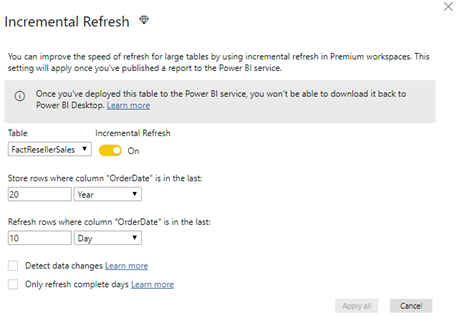
I suggested Microsoft provide a narrative that restates the configuration of the incremental refresh policy. For example, the configuration below means “This policy will load historical data from Jan 1st, 1997 to the current date. Subsequent refreshes will process only the last 10 days to the current system date (UTC time).”
When you deploy to *.pbix file to a premium workspace and navigate to the dataset refresh page, you’ll see that the entire Parameters section is disabled. This is a bug which should be fixed by the time incremental refresh goes out of preview. It should remove or disable only the RangeStart and RangeEnd parameters but enable other query parameters. That’s because the RangeStart and RangeEnd parameter values are not used once the model is published.
Because incremental refresh requires a new schema comparability level, you can’t connect to Power BI Desktop models in SSMS. Incremental refresh also breaks the feature for importing Power BI Desktop files in Azure Analysis Services.
What happens behind the hood?
You should appreciate how simple Power BI incremental refresh is to set up. BI pros know that SSAS partitions take some effort to set up. It gets more complicated when you need to set up rolling partitions and merge partitions. In Power BI, you only need to configure the refresh policy and Microsoft takes care of the rest. Behind the scenes, Microsoft introduced a new partition type that has a refresh policy and parameterized query using the RangeStart and RangeEnd parameters. When the model is refreshed, Power BI expands this partition type and creates the actual table partitions. Considering the above setup, it creates 20 yearly partitions, 1 Quarter partition (for Q1 2018), and 35 daily partitions, assuming the current date is May 5, 2018. These partitions get consolidated and merged over time. For example, once Q2 is full, all daily partitions are merged into a monthly partition, and when the quarter is complete, monthly partitions get merged into a quarterly partition, then quarters get merged into years. Power BI also takes care of removing older partitions when they fall off the range (sliding window).
As the documentation mentions, a “preview” limitation is that subsequent publishing from Power BI Desktop replaces the published refresh policy and triggers a full load on the next refresh. Remember that full load happens once the first time you initiate manual or scheduled refresh of the published dataset. Once the dataset is fully loaded, subsequent refreshes load the dataset incrementally (the last 10 days with the above configuration). Currently, there isn’t a way to reload the dataset (full refresh), such as when you discover the historical data has issues and you need to reload the history, except deleting the dataset and republishing it. I hope that Microsoft will enable access to the Analysis Services Tabular management endpoint to support such scenarios. Or, a better option might be to extend the Parameters section in the refresh page to include an option for full load so that the business user can trigger a full reload.
Query Folding
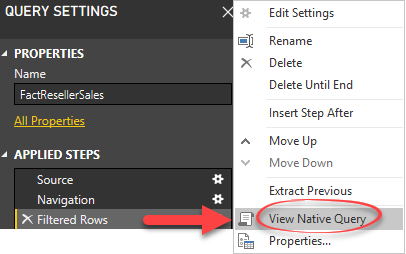
One important consideration to keep in mind is that incremental refresh works best with data sources that support query folding. Such data sources pass through some Power Query transformation steps, such as filtering and grouping, to the underlying data source to improve performance and avoid loading the entire dataset before filtering and grouping is applied. To determine if a specific step is “folded”, right-click the step, such as Filtered Rows, in the Applied Steps pane and observe if the “View Native Query” is enabled.
Although Microsoft doesn’t have an official list of data sources that support query folding and what steps are folded, typically relational data sources and data sources that can handle the SQL WHERE clause support query folding. Excel and text files do not. It’s important to check query folding because it the data source doesn’t support it, Power BI Desktop currently doesn’t prevent incremental refresh but it will load all the data before the filter is applied. Specifically, the query mashup (M) engine will apply the filter as it reads the rows before it gets loaded into the partitions. You might be able to mitigate this performance issue with non-foldable sources by applying the RangeStart/RangeEnd filter when the initial query is sent to the data source. For example, Dynamics Online supports a $filter clause that will work with incremental refresh:
= OData.Feed(“<endpoint url>/sales?$filter=CreatedDate ge ” & Date.ToText(RangeStart) & ” and CreatedDate lt ” & Date.ToText(RangeEnd)”)
Power BI incremental refresh is an important enhancement to the Power BI data architecture. A Power BI premium feature, incremental refresh brings the following benefits for tackling larger datasets: data loads are faster, data loads are more reliable (no long-running connections), and reduced resource consumption.
https://prologika.com/wp-content/uploads/2016/01/logo.png00Prologika - Teo Lachevhttps://prologika.com/wp-content/uploads/2016/01/logo.pngPrologika - Teo Lachev2018-05-08 13:39:372021-02-17 01:01:53Notes on Power BI Incremental Refresh
MS BI fans, join us for the next Atlanta MS BI and Power BI Group meeting on Monday, April 30th at 6:30 PM. Patrick LeBlanc will do a deep dive into Power BI Report Server. TEKsystems will sponsor the meeting. And your humble correspondent will demo several latest Power BI features: buttons and Q&A. For more details, visit our group page and don’t forget to RSVP (use the RSVP survey on the group page) if you’re planning to attend.
Atlanta BI Group April 30th Meeting Reminder
Please RSVP to help us plan food by 2 PM on the day of the meeting by latest:
Choose Yes and submit the RSVP survey found at the right top corner of the page.
Please note that the voting system tracks votes by cookies. If you don’t see the option to submit the survey, clear your browser cookies, or right-click the Internet Explorer icon, and then click Start InPrivate Browsing. Free covered parking is available at South or North Terraces. Or, use the free open non-ticket parking next to North Terraces (coming north on Ashford Dunwoody, turn left on Perimeter Center Terrace and them immediately right).
Presentation:
Power BI Report Server: A Deep Dive
Level: Intermediate
Date:
April 30, 2018
Time
6:30 – 8:30 PM ET
Place:
South Terraces Building (Auditorium Room)
115 Perimeter Center Place
Atlanta, GA 30346
Overview:
So, you think you know everything you need to know about the Power BI Report Server because you use traditional SQL Server Reporting Services. Well, don’t believe it. In this session we are going to discuss topics such as Configuring Kerberos to resolve connectivity issues. We will discuss different authentication types, when you need them, why you need them and how to use them. We will then jump into configuring your report server to host Excel workbooks using Office Online Server. Finally, we will demonstrate how to configure an SSAS Power Pivot instance for the Excel data model. In addition to these topics, we will discuss other advanced topics such as connectivity and high availability during this demo-heavy session.
Speaker:
Patrick LeBlanc is a currently a Data Platform Solutions Architect. Along with his 15+ years’ experience in IT he holds a Master of Science degree from Louisiana State University. He is the author and co-author of five SQL Server books. Prior to joining Microsoft, he was awarded Microsoft MVP award for his contributions to the community. Patrick is a regular speaker at many SQL Server Conferences and Community events.
Sponsor:
People are at the heart of every successful business initiative. At TEKsystems, we understand people. Every year we deploy over 80,000 IT professionals at 6,000 client sites across North America, Europe and Asia. Our deep insights into IT human capital management enable us to help our clients achieve their business goals – while optimizing their IT workforce strategies. We provide IT staffing solutions, IT talent management expertise and IT services to help our clients plan, build and run their critical business initiatives.
Prototypes with Pizza
“Buttons and Q&A Explorer” by Teo Lachev
https://prologika.com/wp-content/uploads/2016/01/logo.png00Prologika - Teo Lachevhttps://prologika.com/wp-content/uploads/2016/01/logo.pngPrologika - Teo Lachev2018-04-23 09:40:482021-02-17 01:01:20Atlanta MS BI and Power BI Group Meeting on April 30th
Thank you to everyone attending the Power BI workshop by Prologika yesterday. We had great turnout with more than 50 people from 30 companies attending the event at the Microsoft Technology Center in Alpharetta! The key takeaways were:
Many companies transition to Power BI because of its great value-to-cost proposition.
PowerQuery is a fantastic tool for data cleansing and transformation that is missing in other competitor offerings.
Power BI can deliver rich visualization capabilities that delight end users and surpass by far the capabilities of traditional reporting tools.
Instead of being a just a stand-alone BI tool, Power BI is a part of a rich ecosystem of products and services that allows you to extend Power BI in versatile ways.
https://prologika.com/wp-content/uploads/2016/01/logo.png00Prologika - Teo Lachevhttps://prologika.com/wp-content/uploads/2016/01/logo.pngPrologika - Teo Lachev2018-04-13 12:24:062018-04-19 07:44:25Another Successful Power BI Workshop
Incremental data refresh: Organizations can use incremental data refresh to scale datasets to even larger sizes. With incremental data refresh, users can load only new or changed data. When creating a dataset in the Power BI Desktop, a user configures a refresh table for each table in the model that is to load incrementally, and then publishes it to a Power BI Premium workspace. Thereafter, each scheduled refresh loads only new or changed data.
Query acceleration for large datasets (Public Preview): Users can create DirectQuery models over any size data in sources, such as Spark and Azure SQL Data Warehouse, and then accelerate common queries by building in-memory aggregations over some of the data. Common queries use the aggregated cache to return results in a fraction of a second instead of directly querying the source. Users can create datasets of massive size and still provide interactive querying.
Why is this important? Because important professional features have crossed the Analysis Services-Power BI line and now business users can build large-scale models using Power BI Desktop. In fact, it looks like “in-memory aggregations” would come first to Power BI as we don’t have them in Analysis Services (yet). Now, I’m not a big proponent of business users building “massive” models (such datasets should be centralized and sanctioned by professionals) but apparently there is a good case for it. In fact, in my “Why Business Like Yours Choose Power BI Over Sisense” blog, I mentioned that SiSense uses this as a competitive advantage. At that time, the maximum Power BI dataset size was 1 GB. If you wanted to build larger models, you had to use Analysis Services, which has a separate price tag, and requires Visual Studio for development. Not to mention that you have to migrate your models from Power BI Desktop to Analysis Services (supported in AAS but not officially supported with on-premises SSAS) and learn new skills.
A lot has changed since. Notably, Power BI Premium raised the maximum dataset size to 10 GB and it’s likely that this limit would be raised further. While I’m not ready to embrace Power BI Desktop for organizational semantic models yet, soon Power BI Premium users will have the option to use a business-user friendly tool (Power BI Desktop) for implementing larger semantic models. And, of course, another important motivation to take this path is reducing licensing cost.
https://prologika.com/wp-content/uploads/2016/01/logo.png00Prologika - Teo Lachevhttps://prologika.com/wp-content/uploads/2016/01/logo.pngPrologika - Teo Lachev2018-03-21 22:24:532018-04-09 16:15:22Power BI Models Scaling Up
MS BI fans, join us for the next Atlanta MS BI and Power BI Group meeting on Monday, March 26th at 6:30 PM. Leo Furlong will introduce you to implementing organizational semantic models with Azure Analysis Services. BlueGranite will sponsor the meeting. And your humble correspondent will demo several latest Power BI features: persistent filters, tooltip pages, and share to anyone. For more details, visit our group page and don’t forget to RSVP (use the RSVP survey on the group page) if you’re planning to attend.
Presentation:
Introduction to Azure Analysis Services
Date:
March 26, 2018
Time
6:30 – 8:30 PM ET
Place:
South Terraces Building (Auditorium Room)
115 Perimeter Center Place
Atlanta, GA 30346
Overview:
Azure Analysis Services (AAS) is an exciting tool within the Azure Data Services tool set. In this session, we’ll learn about the basics of AAS including how to create the service in the Azure portal, options for developing solutions and deploying them, processing data, scaling up and out, security, pricing, and where AAS fits in an overall modern data architecture. At the end of this session, you’ll have a basic understanding of how to get started with the tool and know how it could fit in your organization.
Speaker:
Leo Furlong is an experienced Data and Analytics Principal at BlueGranite with extensive experience implementing Digital Transformation Strategy using on-premise and Azure cloud technologies.
Sponsor:
At BlueGranite we help our clients utilize data as a strategic asset, delivering data architecture and data integration solutions to drive insights and analytics across your organization. Our solutions monitor trends, measure performance, and provide real-time analytics for rapid, informed decision making. We leverage industry leading technology from Microsoft to build modern data platforms that reduce operating costs, increase market share, improve workforce efficiency, and so much more.
https://prologika.com/wp-content/uploads/2016/01/logo.png00Prologika - Teo Lachevhttps://prologika.com/wp-content/uploads/2016/01/logo.pngPrologika - Teo Lachev2018-03-21 09:16:392021-02-17 01:01:19Atlanta MS BI and Power BI Group Meeting on March 26th
With hundreds of vendors out there, choosing a BI tool isn’t easy. If you’ve been following me for a while, you know that I love Power BI. One of the Power BI most prominent strengths is that it’s a part of the much broader Microsoft Data Platform that spans various on-premises and cloud offerings for data storage, processing, and analysis. Thanks to this integration, you can implement real-time dashboards, extend your Power BI reports with predictive capabilities, integrate with Big Data, and much more. In this newsletter, I’ll talk about an exciting integration option: extending Power BI with business applications, thanks to its integration with PowerApps and Flow. And if you happen to be in the Microsoft office in Alpharetta, feel free to ask for a demo of the Power BI Writeback that Prologika prepared and deployed to the Microsoft environment. You’ll be directed to one of the big screens when you can test the report that I mention in this newsletter.
What’s PowerApps?
Every organization requires some sort of custom data-driven apps. And every organization is under pressure to do more with less. Have you used Microsoft Access? If so, you probably remember that Access makes it easy to create data-driven forms. But they were available only in Access and could access only Access database. You might also remember InfoPath – an app for designing, distributing, filling and submitting electronic forms containing structured data which Microsoft discontinued in 2014. Think of PowerApps as the evaluation and replacement of InfoPath. PowerApps is an Azure-hosted service that lets you build data-driven business apps that run in a browser or on mobile devices. Unlike Access and InfoPath, PowerApps supports many cloud or on-premises data sources. Connectivity to on-premises data sources requires installed a data gateway, which is the same software that Power BI uses to tunnel into your corporate network.
Targeting power users and developers, PowerApps requires minimum code and it has its own expression language. In the process of building an app, you specify where you want your data to come from. Then, you choose pre-defined layouts for your forms and link them together. You can develop the app online or by downloading a Windows-based desktop app. Developing the app is free. Sharing the app requires a plan, but if use Office 365, chances are that your O365 business plan already includes PowerApps.
What’s Flow?
As I explained in my “Going with the Flow” blog, Microsoft Flow is another cloud service for creating automation flows without writing code, similar to Zapier’s “zaps” and IFTTT’s “recipes”. Like PowerApps, Flow targets business users and developers willing to create basic multistep flows for automating tasks. For example, you might want to start a workflow when an email is received from specific recipients or containing specific words. Microsoft Flow makes it possible to automate this scenario and many, many more. Business users can connect their accounts, take advantage of pre-built templates, and create their own flows in an easy visual designer. And your PowerApps app can start a flow thanks to the fact that PowerApps and Flow work together.
How Can PowerApps and Flow Enrich BI?
After the integration with Visio, Power BI just took another leap forward with the introduction of the PowerApps custom visual. You can use this visual in your Power BI reports to bridge the Data Analytics and Developer worlds. Now your Power BI apps can integrate with Line of Business (LOB) applications in versatile ways and the app can trigger workflows. All this with minimum code! Suppose you have a Power BI report that shows sales by customers. As the user browses the data, he realizes that some changes need to be made. Granted, the user can open the appropriate business app and make the changes there, and then go back to the report to see the changes. But read-only reports and are so 20th century. Instead, why can’t we allow the user to make the changes on the report by integrating it with PowerApps? This scenario is commonly referred to as writeback.
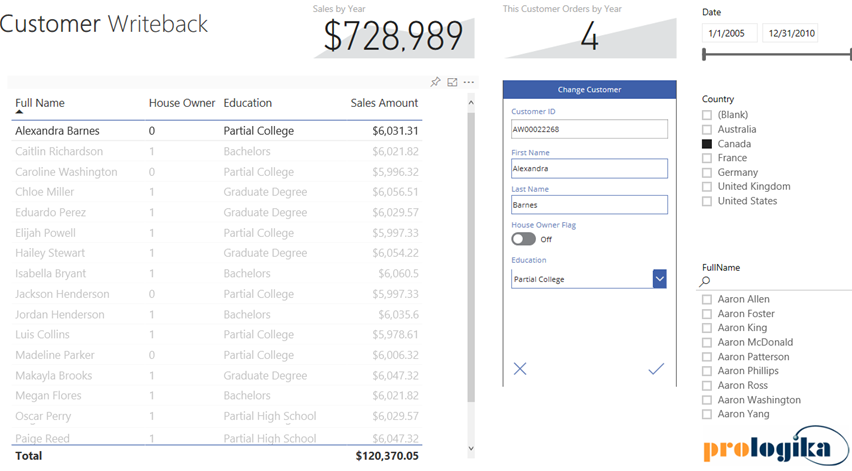
This is exactly the approach my Customer Writeback app demonstrates. The user selects a customer in the table and the customer details show up in the Change Customer visual to the right. This is the PowerApps visual that references my Customer Writeback PowerApps app. The user can make changes in the PowerApps form and save the changes back to the underlying database. Then the user can refresh the report to see these changes. Bringing this one step further, the app can start a workflow, such as when a formal approval is required to approve the changes.
If you have experience with PowerApps, implementing this scenario takes minutes. You can find the implementation steps and source code in my “Power BI Writeback” blog.
The Power BI integration with PowerApps and Flow opens exiting new possibilities and redefines the meaning of a report. These three technologies let you integrate your reports with “smart” applications that you can implement with almost no code! Featuring more than 100 data sources, you can use PowerApps and Flow as an integration hub to mash data from almost any place, create workflows, and then embed PowerApps forms in Power BI reports.
Teo Lachev
Prologika, LLC | Making Sense of Data
Microsoft Partner | Gold Data Analytics




 With hundreds of vendors out there, choosing a BI tool isn’t easy. If you’ve been following me for a while, you know that I love Power BI. One of the Power BI most prominent strengths is that it’s a part of the much broader Microsoft Data Platform that spans various on-premises and cloud offerings for data storage, processing, and analysis. Thanks to this integration, you can implement real-time dashboards, extend your Power BI reports with predictive capabilities, integrate with Big Data, and much more. In this newsletter, I’ll talk about an exciting integration option: extending Power BI with business applications, thanks to its integration with PowerApps and Flow. And if you happen to be in the Microsoft office in Alpharetta, feel free to ask for a demo of the Power BI Writeback that Prologika prepared and deployed to the Microsoft environment. You’ll be directed to one of the big screens when you can test the report that I mention in this newsletter.